Planning a conference is one of the most rewarding and most demanding projects an organizer can take on. You are simultaneously a producer, a marketer, a logistician, a content curator, and a host. The difference between an event that hums and one that limps along usually has very little to do with luck and almost everything to do with the decisions you make in the months before anyone walks through the door. Great conferences feel effortless to attendees precisely because the people behind them did the unglamorous work early.
This guide walks the full lifecycle of a conference, from the first strategic question to the post-event debrief. It is organized around a rough countdown, because timing is the single thing most first-time organizers underestimate. Treat the timeline as a scaffold rather than a straitjacket; a two-hundred-person regional summit and a five-thousand-person flagship conference operate on very different clocks. Adapt the principles, keep the sequence, and you will avoid the costly scramble that defines so many events.
Start with goals and audience, not logistics
Before you book a room or design a logo, answer one question honestly: why does this conference exist? Every later decision (the venue, the ticket price, the speaker lineup, the sponsorship deck) flows from the answer. Vague goals like "bring the community together" feel nice but give you nothing to measure against and nothing to say no to.
Define the outcome you are accountable for
Conferences typically serve one or more of a handful of purposes. Decide which is primary, because you cannot optimize for all of them at once:
- Revenue — the event itself is a profit center, funded by tickets, sponsorships, and exhibitor fees.
- Lead generation — the event exists to fill a pipeline for your organization or your sponsors.
- Community and brand — you are building loyalty, authority, or a movement, and may break even on purpose.
- Education and certification — the value is the content and the credential attendees walk away with.
Write the primary goal down as a single sentence and put it at the top of every planning document. When a decision gets contentious later (do we spend on a keynote or on better catering?), the stated goal settles the argument.
Profile the attendee you actually want
"Everyone in the industry" is not an audience. Build a sharp profile of your ideal attendee: their job title, seniority, the problems keeping them up at night, what they would consider a worthwhile use of two days and a travel budget, and who signs off on their ticket. This profile drives your content tracks, your pricing tiers, your marketing channels, and the pitch you make to sponsors. A conference for senior decision-makers looks nothing like one for early-career practitioners, even in the same field.
If you cannot describe your ideal attendee in enough detail to imagine their calendar, their inbox, and their objections, you are not ready to set a date. Specificity early is what lets everything downstream stay coherent.
Twelve months out: budget, dates, and venue
With goals and audience defined, the foundational logistics become tractable. For a mid-to-large conference, the work in this section ideally begins roughly a year ahead. Smaller events can compress it, but the dependencies are the same: your budget constrains your venue, your venue constrains your dates, and your dates constrain everything else.
Build a budget that models reality
A conference budget is a forecast, not a wish list. Build it in two columns (expenses and revenue) and keep it live throughout planning. On the expense side, account for the obvious line items and the ones that quietly balloon:
- Venue — room rental, but also the food-and-beverage minimum, which is often the larger number.
- Catering — meals, breaks, and the per-head service charges and taxes layered on top.
- Audiovisual and production — staging, sound, screens, recording, and on-site technicians.
- Speakers — fees for headliners, plus travel and lodging even when the talk itself is unpaid.
- Marketing — paid ads, design, email tooling, and content production.
- Staff and volunteers — wages, contractor fees, training, and meals on event days.
- Technology — registration, the event platform, the attendee app, and on-site check-in hardware.
- Signage, badges, swag, and printing.
- Insurance and permits.
- Contingency — set aside a buffer (many organizers use a meaningful percentage of total costs) for the things you cannot foresee.
On the revenue side, model conservatively. Estimate ticket sales at a number you are confident you can hit, not the number you hope for, and treat sponsorship as a range rather than a guarantee until contracts are signed. Identify your break-even attendance early; knowing exactly how many tickets must sell to cover fixed costs turns abstract anxiety into a concrete target you can manage toward.
Choose dates with care
The right date avoids competition and respects your audience's calendar. Check for conflicting industry events, major holidays, school breaks, and religious observances. Mid-week dates often suit business audiences, while weekends can work better for community or consumer events. Give yourself enough runway to sell tickets and recruit speakers; a date that is too close forces compromises on both.
Select and contract the venue
Visit venues in person whenever you can. A floor plan cannot tell you whether the breakout rooms are actually within walking distance of the main hall, whether the loading dock will fit your production trucks, or whether the wifi collapses when a few hundred devices connect at once. When evaluating a venue, scrutinize:
- Capacity and layout — for your main stage, your breakouts, your exhibitor floor, and the flow between them.
- Connectivity — dedicated bandwidth for staff and registration, separate from attendee wifi.
- Accessibility — step-free routes, accessible restrooms, and clear signage for attendees with disabilities.
- In-house versus outside vendors — some venues require you to use their AV and catering, which materially changes your budget.
- The contract terms — read the cancellation, attrition, and force-majeure clauses closely before you sign. These are where the financial risk lives.
Nine to six months out: the call for proposals and speakers
Content is the reason people come, and strong content takes time to assemble. Open your call for proposals (CFP) early enough that you can be selective rather than scrambling to fill slots in the final weeks.
Run a CFP that attracts the right submissions
A good CFP makes it easy for the right speakers to say yes and easy for you to evaluate fairly. Before you open it, decide what tracks and session formats you want, then write the prompt so submissions map cleanly onto them. Collect, at minimum, the proposed title, an abstract, the intended audience and level, the format, and the speaker's background. With a platform like BoothHQ, you can publish a branded CFP page, accept structured submissions, and keep every proposal in one reviewable pipeline rather than scattered across email and spreadsheets.
Promote the CFP deliberately. Email your past attendees and speakers, post in the communities your audience lives in, and ask your advisory network to nominate people. The best speakers rarely find your CFP by accident; you have to put it in front of them.
Review proposals consistently and inclusively
Define your selection criteria before reading a single submission, and apply them uniformly. A simple rubric scoring relevance, originality, speaker credibility, and fit with your tracks keeps the process honest and defensible. Where you can, review with the speaker's name and company hidden to reduce bias toward familiar brands. Aim for a lineup that is diverse across perspective, background, and experience level; a stage that all looks the same signals to a chunk of your audience that the event is not for them.
Manage speakers like the partners they are
Once selected, speakers need a clear, low-friction experience or they become a source of last-minute chaos. Set expectations in writing: deadlines for slides and bios, technical requirements, travel and reimbursement policy, and what you are providing (and not providing). Maintain a single source of truth for speaker details, headshots, session abstracts, and AV needs so the same information feeds your website, your agenda, your app, and your on-site signage without anyone re-typing it. A well-run speaker desk is invisible to attendees and a lifesaver to you.
Six to four months out: agenda, tracks, and registration
With speakers confirmed, you can turn raw sessions into a coherent program and open the doors to ticket buyers.
Build an agenda that respects attention
An agenda is a narrative, not a grid to be filled. Group sessions into tracks that map to your audience's distinct interests so attendees can plot a clear path through the day. As you schedule, account for the human realities:
- Put your strongest, most energizing content in the morning and immediately after lunch, when attention dips.
- Build in real breaks — people need time to move between rooms, network, visit exhibitors, and simply rest. A back-to-back schedule exhausts everyone and starves your sponsors of foot traffic.
- Avoid pitting two of your strongest sessions against each other in the same time slot; you force a painful choice and split your best rooms.
- Match session length to format. A panel and a hands-on workshop should not be boxed into the same forty-five-minute slot by default.
- Mind room capacity against expected demand. Schedule the sessions you predict will draw crowds into your largest rooms.
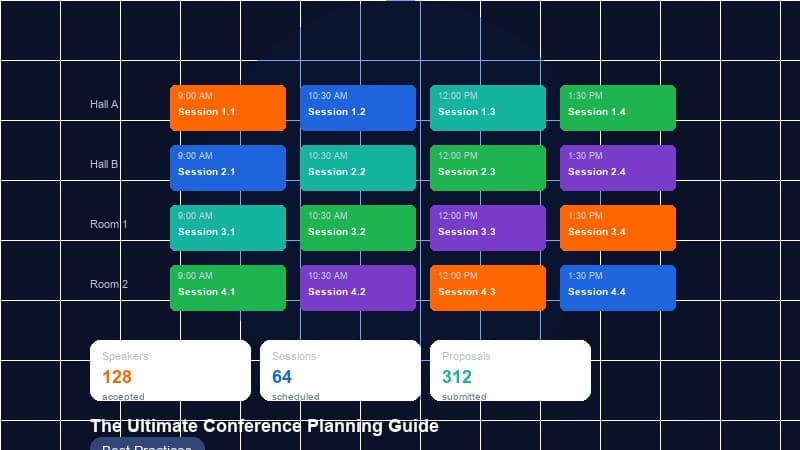
Room scheduling is where agenda mistakes become physical: an overflowing room with people sitting on the floor while a half-empty room sits next door is a planning failure, not bad luck. Modeling capacity against expected demand ahead of time, and adjusting the schedule accordingly, is far cheaper than fixing it onsite.
Design registration and ticketing tiers
Your ticketing strategy shapes both revenue and the urgency that drives early sales. A few structures work reliably:
- Time-based tiers — early-bird, regular, and late pricing create a clear reason to buy now rather than later.
- Audience tiers — separate prices for individuals, teams, students, and nonprofits widen access without devaluing the main ticket.
- Bundles and group rates — encourage teams to attend together and lift your average order value.
- Add-ons — workshops, certification, or a VIP experience let enthusiastic attendees spend more.
Whatever structure you choose, make the registration experience fast and trustworthy. A confusing or slow checkout is a silent killer of conversions. The flow should capture the data you genuinely need (for badges, dietary requirements, accessibility needs, and session planning) without turning the form into an interrogation. Send a clear confirmation immediately, and make it effortless for attendees to transfer or update their registration, because plans change. Keeping registration, payment, and the attendee record in one system means your check-in list, your app, and your reporting all draw from the same accurate source.
Six to three months out: sponsorship and exhibitors
For many conferences, sponsorship and exhibitor revenue is what turns a break-even event into a profitable one, and it is what funds the experience your attendees enjoy. Start these conversations early; sponsorship budgets get committed months in advance, and the best partners need lead time.
Build packages around outcomes, not logos
Sponsors do not want a logo on a banner; they want access to your audience and a measurable return. Build tiered packages that escalate in value, and describe each benefit in terms of what the sponsor gets out of it:
- Visibility — branding on signage, the website, the app, and stage screens.
- Access — speaking slots, a booth in a high-traffic location, or hosting a session or networking event.
- Leads — badge scanning, opt-in attendee lists, and qualified introductions.
- Experience — sponsoring the things attendees love, like the lounge, the coffee, the party, or the wifi.
Be honest about what you can deliver. Promising "five hundred leads" you cannot guarantee is the fastest way to lose a sponsor for next year. Frame your audience in terms sponsors care about (seniority, buying authority, industry) and let the quality of the room do the selling.
Manage the exhibitor floor as a product
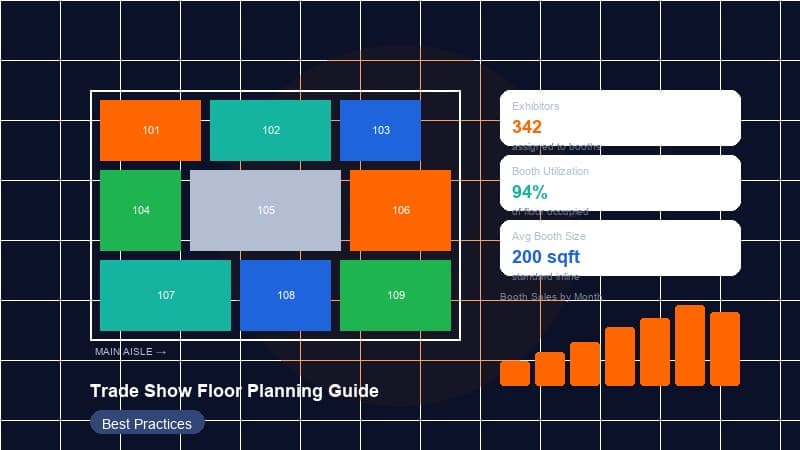
The exhibitor floor only works when there is traffic, so design for it. Place food, breaks, and high-demand sessions in or near the exhibition hall so attendees naturally pass through. Offer a clear floor plan and let exhibitors choose or be assigned booths with full visibility into what is available, which removes a huge amount of back-and-forth. Give exhibitors a straightforward way to manage their booth details, staff passes, and lead capture so they arrive prepared. A floor where exhibitors feel they got value is a floor that rebooks next year.
Six to one month out: marketing and promotion
You can assemble a flawless program and still have an empty room if you do not market it well. Promotion is not a single announcement; it is a sustained campaign that builds from awareness to urgency over months.
Sequence your campaign
Roughly map your marketing to the countdown:
- Six-plus months out — announce the event and open early-bird registration. Lean on the strength of your venue, your theme, and any marquee speakers already confirmed.
- Four to three months out — roll out the speaker lineup and agenda as they firm up. Each confirmed speaker is a fresh reason to post, email, and ask that speaker to share with their own audience.
- Two months out — push hard on the value of attending: the sessions, the networking, the takeaways. Use testimonials and content from past events if you have them.
- The final month — create urgency. Price tiers expiring, sessions filling, and "see who's attending" messaging convert the people who have been on the fence.
- The final week — shift to logistics. Send attendees everything they need to show up prepared: schedule, app download, directions, parking, and what to bring.
Use every channel your audience actually uses
Email remains the workhorse of event marketing because it reaches people who already know you. Segment your list so past attendees, prospects, and lapsed registrants each get a relevant message. Beyond email, lean on the channels where your specific audience lives, which you defined back when you profiled them: the right professional community, the right social platform, the right newsletters and partners. Equip your speakers, sponsors, and past attendees with ready-made assets so they can amplify on your behalf; word of mouth from a trusted peer outperforms any ad you can buy.
Your most powerful marketers are the people already invested in the event. A speaker sharing their session, a sponsor promoting their booth, and a past attendee posting "going again this year" each carry more credibility than your own megaphone ever will. Make it trivially easy for them to do it.
One month to event day: the attendee experience
As the event approaches, the focus shifts from selling to delivering. The attendee experience begins well before the doors open and is shaped heavily by the tools you put in attendees' hands.
Put the conference in their pocket
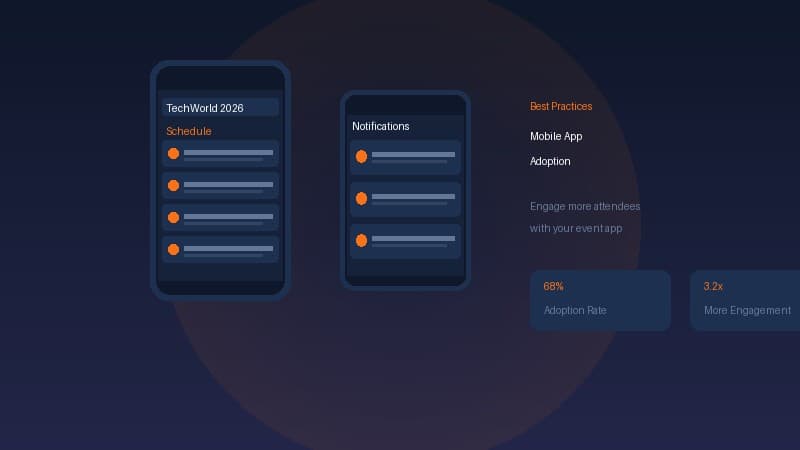
A dedicated attendee mobile app has become the connective tissue of a modern conference. At minimum it should carry the full agenda, speaker and session details, a venue map, and real-time announcements. The feature that consistently earns its keep, though, is a personal planner. With My Show Planner in BoothHQ, attendees browse the agenda, bookmark the sessions they want, and build a personalized schedule with reminders, so they spend the day moving with intention rather than wandering and missing the talks they came for. The same app becomes your channel for instant updates when a room changes or a session runs late, replacing the chaos of printed errata and word of mouth.
Design for networking, because that is why many come
For a large share of attendees, the conversations matter as much as the talks. Engineer serendipity rather than hoping for it:
- Build in unstructured time and comfortable spaces where conversations can actually happen.
- Offer in-app attendee directories and messaging so people can find and reach the peers they want to meet.
- Host targeted gatherings (topic tables, first-timer meetups, role-based mixers) that give shy attendees an easy on-ramp.
- Make introductions deliberate where you can; helping the right two people meet is a memory attendees attribute to your event.
Sweat the small comforts
The details attendees rarely mention when they are right and always mention when they are wrong: clear signage, fast check-in, accessible spaces, good coffee, reliable wifi, charging stations, and food that accommodates dietary needs. None of these are glamorous, and all of them shape whether someone leaves saying the event was well run.
Event week: run-of-show and onsite logistics
The days immediately before and during the event are where preparation meets reality. The organizers who stay calm are the ones who planned the chaos in advance.
Write the run-of-show
A run-of-show is the minute-by-minute script for event day: who is doing what, where, and when, from doors opening to the final teardown. It names the owner for every transition, the cues for AV, the timing of meals and breaks, and the plan for each session's introduction and Q&A. Distribute it to your whole team and walk through it together before the event. When something goes sideways (and something always does), the run-of-show is what keeps a hiccup from becoming a crisis.
Prepare your people and your space
- Staff and volunteers — recruit enough hands, assign clear roles, and brief everyone on the schedule, the layout, and the escalation path for problems. A volunteer who knows where the nearest restroom and the first-aid kit are is worth far more than one who does not.
- Check-in — make it fast. Long registration lines set a sour tone for the whole event. Self-service kiosks, pre-printed or on-demand badges, and a digital check-in list that updates in real time keep the queue moving.
- The walkthrough — do a full physical walkthrough the day before: test the AV in every room, confirm signage placement, verify the wifi under load, and rehearse the opening.
- Contingency plans — know what you will do if a speaker cancels, a session overflows, the AV fails, or the weather turns. Have backups and a clear decision-maker for each.
Capture the moment
The event is also your best source of marketing material for next year. Plan photography and video, capture testimonials while attendees are energized, and record sessions if your speakers have agreed to it. Content captured live is worth far more than anything you can manufacture afterward, and it costs almost nothing to plan for in advance.
After the event: measure, learn, and reset
The conference is not over when the last attendee leaves. The post-event window, while everything is fresh, is when you learn what to repeat and what to fix, and when you lay the groundwork for next time.
Measure against the goal you set
Return to the single sentence you wrote at the very beginning and measure honestly against it. Depending on your goal, the metrics that matter might include:
- Financial — actual revenue versus budget, profit or loss, and revenue per attendee.
- Attendance — registrations, actual turnout, no-show rate, and session-level attendance.
- Satisfaction — survey scores, net promoter score, and qualitative feedback.
- Engagement — app usage, sessions planned and attended, and networking activity.
- Sponsor and exhibitor outcomes — leads delivered, satisfaction, and intent to return.
Send your attendee survey while the experience is fresh, and keep it short enough that people actually finish it. Survey your speakers, sponsors, and your own team too; each sees a different slice of what worked and what did not.
Debrief, document, and protect your renewals
Gather your team for an honest post-mortem within a week or two, before memories fade. Document what to keep, what to change, and the things you swore you would never forget but absolutely would by next year. This living document becomes the head start for your next event and is one of the most valuable assets you own as an organizer.
Finally, move quickly on relationships while goodwill is high. Thank your speakers, sponsors, volunteers, and attendees personally. Follow up with sponsors with their results and an early conversation about next year; renewing a happy sponsor is far easier than finding a new one. Open early-bird registration for next year while this year's experience is still vivid in attendees' minds. The end of one conference is the beginning of the next.
Key takeaways
- Start with why. Define a single primary goal and a sharp audience profile before any logistics; every later decision should trace back to them.
- Respect the timeline. Budget, dates, and venue around twelve months out; CFP and speakers six to nine months out; agenda and registration four to six; sponsorship in parallel; marketing sustained across the final six months.
- Budget conservatively and know your break-even. Model revenue cautiously, account for the line items that balloon, and always hold a contingency buffer.
- Run a deliberate CFP and treat speakers as partners. Clear criteria, inclusive review, and a low-friction speaker experience produce a stronger lineup with less chaos.
- Build the agenda as a narrative. Tracks, real breaks, smart room scheduling, and no head-to-head clashes between your best sessions.
- Make sponsorship about outcomes. Sell access and measurable return, design the floor for traffic, and never overpromise.
- Market as a sustained campaign that builds from awareness to urgency, and mobilize your speakers, sponsors, and past attendees as your most credible promoters.
- Invest in the attendee experience. A mobile app with a personal planner, designed-in networking, and the small comforts done right are what people remember.
- Script the day and prepare your people. A detailed run-of-show, fast check-in, a full walkthrough, and contingency plans keep event day calm.
- Measure against your goal, debrief while it is fresh, and protect renewals. The end of one conference is the start of the next.
No single tool replaces good judgment and hard work, but the right platform removes an enormous amount of friction. Keeping your CFP, agenda, room scheduling, registration, sponsorships, and the attendee app in one connected system means your data stays consistent from the first proposal to the final report, and frees you to spend your energy on the things only an organizer can do: curating great content, building real community, and hosting an event people remember.