For most trade show and expo teams, the floor plan has lived its whole life as a PDF. A designer exports it, someone emails it to the sales team, sales marks up which booths are sold in a spreadsheet, ops keeps a separate copy with their own notes, and management asks for "the latest version" three times a week. Every attachment is a snapshot of a moment that has already passed. By the time the file lands in someone's inbox, two more booths have been promised on a phone call nobody else heard.
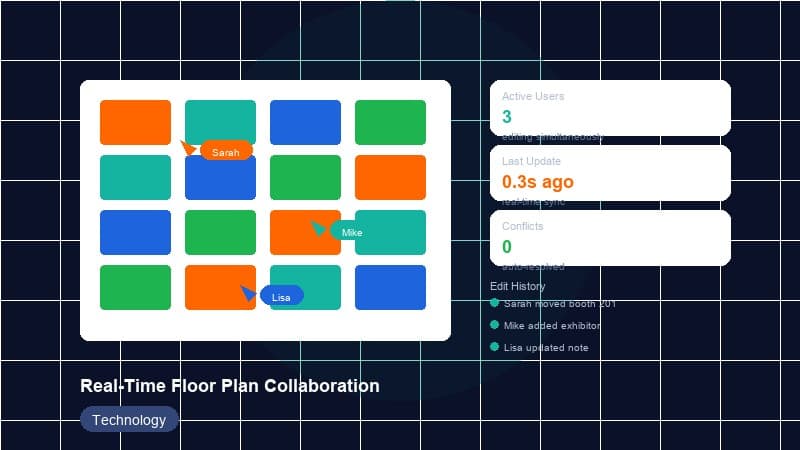
This is the world real-time floor plan collaboration replaces. Instead of trading static files, your entire team works on a single live canvas — the same plan, updated the instant anyone touches it. When a salesperson closes booth 214, it turns "sold" on everyone's screen at once: the ops lead provisioning power and internet, the manager watching the revenue line, and the self-service buyer browsing availability from their phone. There is no "latest version" because there is only one version, and it is always now.
The hidden costs of static and PDF floor plans
The PDF workflow feels cheap because it has no line item. The costs are real, they just hide inside everyday friction.
- Double-booked booths. The classic failure. Two reps each have a copy that says a booth is open, and both sell it. Now you are choosing which exhibitor to disappoint, often a sponsor you cannot afford to upset.
- Version drift. The moment a plan is exported, it begins to rot. People hoard their own annotated copies. The "v7_FINAL_final2" naming convention is a symptom of a team that has lost the single source of truth.
- Reconciliation overhead. Someone spends hours every week merging the sales spreadsheet, the ops markup, and the designer's master into one accurate picture — work that produces nothing except a number that is stale again by Friday.
- Slow answers. When a prospect asks "what's left near the main stage?", the rep cannot answer with confidence. They have to check, ask around, and call back. Hesitation costs deals.
None of these are exotic. They are the default experience of running a show on email and spreadsheets, and they scale badly: the bigger and more desirable the show, the more expensive every one of these problems becomes.
What real-time collaboration actually changes
It is tempting to describe live collaboration as "a faster PDF," but that undersells it. The change is structural, not cosmetic.
One live canvas for sales, ops, and management
Different teams have always needed different views of the same floor. Sales cares about price tiers and what is closing. Ops cares about utilities, fire lanes, and load-in. Management cares about square footage sold and revenue pacing. On a live canvas, those are layers on one shared plan rather than three documents that have to agree. Everyone is looking at the same booths, so when they talk about booth 214 they are talking about the same booth, in the same state, at the same moment.
Version conflicts simply stop existing
This is the quiet revolution. When the plan is a shared, server-backed object instead of a file, there is nothing to copy and therefore nothing to fall out of sync. Two people can edit at the same time and see each other's cursors and changes immediately. The whole category of "wait, which version are you looking at?" disappears, and with it the reconciliation work that version drift used to demand.
Instant availability for self-service buyers
Once the plan is live internally, you can safely expose it externally. A prospective exhibitor can open your floor plan, see exactly which booths are open right now, pick one, and pay — without a single email. Because availability is driven by the same data your team sells from, there is no window where the public map and the internal truth disagree. Self-service stops being risky and starts being a sales channel that runs while your team sleeps.
The shift from "email me the floor plan" to "watch the floor plan fill in front of you" is the difference between selling a show and merely tracking one.
How it speeds the sell-out
Selling out faster is mostly about removing delay between intent and commitment. Static plans inject delay at every step; live plans remove it.
- Reps answer instantly. "Yes, 214 is open, I can hold it while you decide" is a closing line. It only works when the rep trusts the screen in front of them.
- Holds and sales propagate immediately. A booth marked held or sold updates everywhere at once, so no second rep wastes a pitch on inventory that is already gone.
- Self-service captures the impatient buyer. Plenty of exhibitors would rather click and pay than schedule a call. An always-current public map lets them, and every self-service sale is one your team did not have to chase.
- Scarcity becomes visible and honest. When buyers can see the good spots disappearing in real time, urgency does the selling for you — and it is credible, because it is real.
Cross-team workflow in practice
The everyday rhythm of a show changes when the plan is shared. A sales call that ends in a commitment becomes an instant update the ops team sees and can immediately attach requirements to — power drops, carpet, signage. Management does not have to ask for a status report because the status is the plan; revenue and remaining inventory are simply readable off the canvas. When a layout has to change — a sponsor upgrades to a larger footprint, a fire marshal requires a wider aisle — the edit happens once and everyone is already on the new reality.
This also tightens accountability without adding bureaucracy. Because changes happen on a shared object, it is clear what changed and what the current state is. Nobody can be working from an outdated map and "not have gotten the memo," because there is no memo — there is just the plan.
What exhibitors and attendees gain
An always-current plan is not only an internal convenience; it is a better experience for the people you are selling to and serving.
For exhibitors
They get to choose their location with confidence, seeing real availability rather than a stale snapshot. They are far less likely to suffer the worst experience in trade shows — being told the booth they "bought" was actually sold to someone else. And they can act on their own schedule, including outside your office hours.
For attendees
When the same live plan powers the public-facing map, attendees navigate a floor that matches reality: the booths that exist, where exhibitors actually are, and any last-minute changes. A map that is wrong on day one erodes trust in everything else; a map that is simply correct is invisible in the best way.
Key takeaways
- PDF floor plans have hidden costs: double-bookings, version drift, constant reconciliation, and slow answers that cost deals.
- Real-time collaboration is structural, not cosmetic: one live canvas replaces many copies, so version conflicts cannot occur.
- Live data makes self-service safe: a public map driven by the same truth your team sells from becomes a 24/7 sales channel.
- It speeds the sell-out by removing delay between buyer intent and commitment, and by making scarcity visible and honest.
- It improves cross-team workflow: sales, ops, and management read and edit one shared reality instead of trading status updates.
- Exhibitors and attendees benefit from a plan that is always current — fewer disputes, more confidence, a floor map that matches the room.