For most of the last decade, "technology at trade shows" meant a better badge scanner and a slightly faster Wi-Fi network. That era is over. Artificial intelligence has quietly moved from the keynote stage to the operational core of how modern events are planned, sold, and experienced. The change is not a single flashy feature but a steady accumulation of small intelligences working behind the scenes: who you should meet, which sessions are worth your time, when to send a notification, and what next year's floor plan should look like.
For organizers and exhibitors alike, 2026 is the year these capabilities stop being experimental and start being expected. Attendees who use AI-powered recommendations at one show notice their absence at the next. The platforms that win are the ones that treat AI as connective tissue between people, content, and commerce, not as a chatbot bolted onto the registration page. Here is where the real transformation is happening.
Matchmaking That Actually Matches
The single most valuable thing a trade show offers is the right conversation with the right person. For years, "networking" meant scanning a printed exhibitor list and hoping. AI-driven matchmaking replaces that guesswork with intent modeling: the platform learns what an attendee is looking for from their registration answers, their session bookmarks, the booths they linger on, and the content they engage with, then surfaces the exhibitors, sponsors, and peers most likely to be worth their time.
For exhibitors
Matchmaking flips the cold-traffic problem on its head. Instead of waiting for whoever wanders by, exhibitors receive a ranked list of attendees whose stated goals align with what they sell. That lets a small booth team spend its limited hours on the twenty conversations that matter rather than two hundred that don't. Pre-show, it enables meeting requests that arrive with context already attached.
For organizers
Better matches mean better outcomes, and better outcomes mean renewals. When an organizer can show an exhibitor that the platform delivered qualified, intent-matched introductions, the value of a booth becomes measurable rather than anecdotal. Matchmaking quietly becomes a retention engine.
Lead Intelligence and Scoring
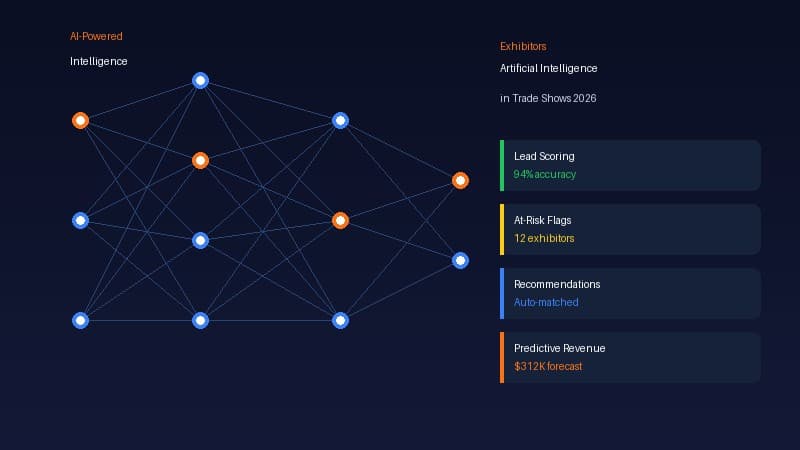
Capturing a lead has never been the hard part. Knowing which leads deserve a follow-up call on Monday and which can wait is where most exhibitors lose deals. AI lead scoring closes that gap by combining behavioral signals into a single, defensible priority ranking.
- Engagement depth — how long someone spent at the booth, what they scanned, which materials they downloaded.
- Fit signals — role, company size, and stated needs drawn from registration and conversation notes.
- Buying-stage cues — questions asked, demos requested, and repeat visits across days.
The result is a lead list that arrives already sorted by likely value, often with a suggested next action attached. The most useful systems also summarize the conversation, so a rep who scanned forty badges in an afternoon doesn't have to reconstruct each one from memory. Lead intelligence turns the post-show scramble into a focused, prioritized sequence, which is the difference between a show that pays for itself and one that becomes a stack of forgotten business cards.
Personalized Agendas and Recommendations
A large expo can offer hundreds of sessions across several days, more than any individual could ever evaluate by hand. AI-built agendas solve the discovery problem by treating each attendee's time as a scheduling puzzle to optimize: relevant sessions first, conflicts flagged, travel time between rooms accounted for, and gaps filled with exhibitors or networking that fit the person's goals.
This personalization compounds throughout the event. As an attendee attends sessions and skips others, the recommendations sharpen. Someone who keeps choosing technical deep-dives stops seeing introductory panels. The agenda becomes a living document rather than a static printout, and attendees consistently report that a well-curated schedule is one of the strongest drivers of how much value they feel they got from a show.
The goal of personalization isn't to show people more — it's to show people less, but better. A focused attendee is an engaged attendee, and an engaged attendee comes back.
Smart and Sponsored Notifications
Push notifications are powerful and easily abused. Blast everyone with the same alert and you train people to silence your app. AI changes the calculus by deciding not just what to send but when and to whom.
Timing and relevance
A smart notification engine learns each attendee's rhythm and only interrupts when the message is genuinely relevant: a session they bookmarked is starting in ten minutes, a matched exhibitor is free for a quick meeting, or a room change affects a talk on their agenda. Relevance protects the channel so the messages that matter actually get read.
Sponsored opportunities done right
For organizers, intelligent targeting unlocks a new revenue line. A sponsor can pay to reach the attendees most likely to care about their offering, rather than spamming the entire floor. Because the targeting is intent-based, sponsored messages feel more like helpful suggestions than ads, which keeps both attendees and sponsors satisfied. This is one of the clearest examples of AI creating value on both sides of the ledger at once.
Content and Session Discovery
The content produced at a major conference doesn't have to evaporate when the lights go down. AI now indexes session recordings, slide decks, and transcripts so attendees can search by concept rather than by title, ask natural-language questions, and receive a clip or summary in response. "What did anyone say about supply-chain resilience?" becomes a searchable query instead of a lost opportunity.
This extends the lifespan of an event far beyond its dates. On-demand, AI-summarized libraries give attendees a reason to stay engaged for weeks, give exhibitors recurring exposure, and give organizers a year-round asset that supports sponsorship and registration for the next edition. Content discovery turns a three-day event into a continuous relationship.
Predictive Analytics for Organizers
Behind the attendee-facing magic sits the capability that may matter most to organizers: prediction. Historical and live event data feed models that forecast outcomes early enough to act on them.
- Attendance and pacing — projecting final registration from current trends so marketing spend can be adjusted while it still counts.
- Floor and booth demand — identifying which booth locations and sponsorship tiers will sell out, informing pricing and layout for the next show.
- Session capacity — anticipating which rooms will overflow so they can be reassigned before disappointment sets in.
- Revenue and renewal risk — flagging exhibitors whose engagement suggests they may not return, in time for a human to intervene.
The shift here is from reporting to foresight. A traditional dashboard tells you what happened after it's too late to change it. Predictive analytics tells you what is likely to happen while there is still room to influence it, which is the difference between managing an event and steering it.
What AI Still Can't Replace
For all of this, it's worth being clear-eyed about the limits. AI is exceptionally good at ranking, matching, summarizing, and forecasting. It is not a substitute for the things that make people show up in person in the first place.
The handshake after a great conversation, the trust built over a shared meal, the spark of an unplanned hallway encounter, the judgment of an experienced organizer who senses the mood of a room and changes the program on instinct — none of that is on the roadmap for automation, and it shouldn't be. AI's proper role is to clear away the noise and friction so that human connection has more room to happen. The best events in 2026 use AI to handle the logistics of attention and surface the right opportunities, then get out of the way and let people be people.
Organizers who treat AI as a replacement for hospitality and curation will produce efficient, soulless events. Those who treat it as an amplifier for both will produce events people fight to attend.
Key takeaways
- Matchmaking is the new core value — intent-based introductions turn floor traffic into qualified conversations and quietly drive exhibitor renewals.
- Lead scoring beats lead capture — prioritized, summarized leads convert; stacks of un-triaged scans do not.
- Personalization means less, not more — curated agendas and recommendations keep attendees focused and engaged.
- Smart notifications protect the channel — relevance and timing make sponsored messaging a revenue line instead of an annoyance.
- Content discovery extends the event — searchable, summarized sessions create a year-round asset.
- Predictive analytics enable steering, not just reporting — forecast attendance, demand, and renewal risk early enough to act.
- AI amplifies human connection, it doesn't replace it — use it to remove friction so the handshakes, trust, and serendipity have more room to happen.